If you’ve ever stepped into a data center, server room, or even a modern office with underfloor cabling, you’ve probably noticed those removable panels sitting a few inches above the concrete floor. They’re called raised floor panels, and if you’re in the market for them, one question’s almost certainly crossed your mind: are they fire-resistant? As a supplier who’s spent years talking to installers, facility managers, and IT directors, I get it—fire safety isn’t something you want to mess around with, especially in spaces full of expensive gear and critical wiring. Let’s break this down without all the jargon, so you can get the straight answer instead of some generic marketing fluff. Raised Floor Panels

First off, let’s clear up a common myth: no raised floor panel is 100% fireproof. If you expose any panel to enough heat or flame for long enough, it will burn. But “fire-resistant” doesn’t mean “indestructible”—it means it can slow a fire down, stop it from spreading quickly, and give people time to respond. That’s the key point most suppliers skip over, so let’s start with the basics of what raised floor panels are made of, because that’s where their fire properties come from.
Most standard raised floor panels fall into three main material types: steel, concrete, and wood-composite. Steel panels are the heavy hitters here. They’re basically a steel frame filled with either concrete or a lightweight core, then covered with a laminate or vinyl finish. Here’s the thing about steel: it doesn’t burn. A steel panel won’t contribute fuel to a fire, which is a huge advantage. But wait—steel does weaken when it gets hot. Studies show that at around 1,100°F (that’s about 590°C), structural steel loses half its strength. So a panel might not catch fire, but if the surrounding area is burning hot enough, it could warp or collapse. That’s something to keep in mind, especially in spaces where fires can reach those temperatures, like server rooms with high-voltage equipment.
Then there are concrete-core panels. These are heavier than steel, mostly used in data centers that need extra weight to support heavy server racks. The core is cement mixed with aggregate, so it’s non-combustible. The only part that could burn is the top finish—usually a vinyl or linoleum layer. Even then, good quality finishes are treated with flame retardants, so they won’t release toxic fumes or spread fire quickly. I’ve had customers install these in colocation facilities, and they tell me the panels usually meet local fire codes, which is a big deal.
Wood-composite panels, though—these are the ones you need to be careful with. They’re cheaper, often used in smaller offices or retail spaces, but their core is made of particleboard or medium-density fiberboard (MDF), which is combustible. That doesn’t mean they’re useless, though. Many of these panels are treated with fire retardant chemicals during manufacturing, so they have a “flame spread rating” that’s way better than untreated wood. The National Fire Protection Association (NFPA) has a standard called NFPA 70, which covers electrical installations, and it sets limits for flame spread in building materials. Most treated wood-composite panels will hit a rating of 25 or lower on a scale where 0 is no flame spread and 100 is like regular pine. That’s more than enough for most commercial spaces, but if you’re dealing with high-heat areas, you’ll want to skip these.
Now, it’s not just the panel itself that matters—fire resistance also depends on how you install the raised floor system. I’ve seen customers cut corners here, and that’s when fire risks pop up. For example, the gaps between panels: if they’re not sealed properly, flames and smoke can move through the underfloor plenum (that’s the space between the raised floor and concrete) really fast. Good installers use fire-resistant sealant between panels, and they make sure any penetrations—like where cables go through—are sealed with fire-stopping material. If you leave those gaps open, a small fire under the floor can turn into a big one in minutes, no matter what the panels are made of.
Another thing people forget: the underfloor plenum itself. In a lot of spaces, that’s where all the power cables, network cables, and sometimes even HVAC ducts run. If you don’t use fire-rated cables or add fire barriers in the plenum, flames can spread through the cable insulation super quickly. Even the best panels won’t stop that. As a supplier, I always tell customers that fire resistance is a system, not just the panels. You can have the most fire-resistant steel panels, but if you skip the cable rating or fire stops, you’re setting yourself up for trouble.
Let’s talk about certifications, because that’s how you know a panel actually meets safety standards. A lot of suppliers will slap a “fire-resistant” label on their products, but you need to look for third-party certifications. The two big ones in the US are UL (Underwriters Laboratories) and FM Global. UL 2043 is the standard specifically for plenum-rated materials, so if a panel is UL 2043 listed, that means it’s been tested to not spread flame or release toxic fumes in a plenum space. FM Global does their own testing too, focusing on how the panels perform in real-world fire scenarios, not just lab tests. I make sure all the panels we supply have these certifications, because if they don’t, they’re just words on a box.
I also get asked a lot about smoke and toxic fumes. When a lot of people think of fires, they picture flames, but most fire deaths are from smoke inhalation. So even if a panel doesn’t burn much, if it releases a bunch of toxic fumes when it does, that’s a problem. Again, the material matters: steel and concrete panels release almost no fumes when heated, while wood-composite panels (even treated ones) can release some. But good fire-retardant treatment reduces that a lot. The NFPA also has a standard for smoke density, so look for panels that meet that too—low smoke density means safer air if there’s a fire.
Wait, let’s address a common mistake I see: people thinking all raised floors in data centers need the highest fire rating. That’s not true. A small office server closet might be fine with treated wood-composite panels and basic fire stopping, while a hyperscale data center with thousands of servers needs steel or concrete-core panels with extra fire barriers in the plenum. It all depends on the space’s use, the equipment inside, and local fire codes. As a supplier, I work with customers to figure out exactly what they need, not just push the most expensive panel.
Let me share a quick example. A few years back, we supplied panels for a startup’s server room. They initially went for cheap untreated wood-composite panels, but when we checked their local fire code, we found that their city required plenum-rated materials with a flame spread under 25. Untreated wood-composite was at 75, which would have failed inspection. We switched them to treated wood-composite panels, which hit a flame spread of 15, and added fire-stopping around the cable penetrations. They passed inspection, saved money compared to steel, and had the fire resistance they needed. That’s the kind of thing I love helping with—no one-size-fits-all solution.
Another question: how do you test a panel’s fire resistance? It’s not just setting a panel on fire and timing how long it takes to burn. UL 2043 testing, for example, puts a panel in a chamber with controlled flame and measures how far the flame spreads, how much smoke it releases, and how the material holds up. They also test for “flashover” — that’s when all the combustible materials in a space ignite at once, which is super dangerous. A good panel will delay flashover, giving people time to evacuate and firefighters time to get there.
Now, what about maintenance? Fire resistance doesn’t last forever. If you scratch a steel panel, that exposed metal might rust over time, and rust can make it weaker when heated. If you damage the finish on a wood-composite panel, the fire retardant might be compromised. I tell customers to inspect their raised floor every year—check for damaged panels, loose seams, and broken fire stops. That’s not overkill; it’s how you keep the fire resistance working as it should.
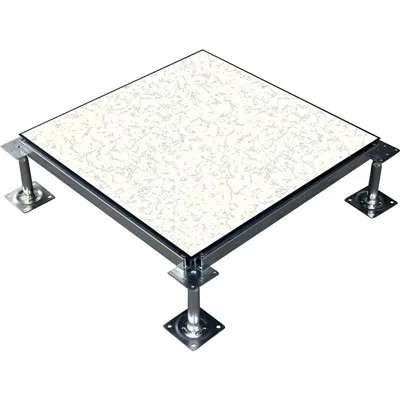
Let’s wrap this up with the key takeaways, because I don’t want you to walk away confused. First: no raised floor panel is fireproof, but many are fire-resistant enough for most spaces. Second: the material matters—steel and concrete panels are best for high-heat or critical spaces, treated wood-composite works for low-heat commercial spaces. Third: fire resistance is a system, not just panels—seal gaps, use fire-rated cables, add plenum barriers. Fourth: always look for third-party certifications like UL 2043 or FM Global, don’t just take a supplier’s word for it. Fifth: match the panel to your space, don’t overspend on a steel panel for a small office, but don’t cut corners on a data center.
Data Center Raised Access Floor At the end of the day, raised floor panels’ fire resistance is about performance, not marketing. If you’re in the market for panels and want to make sure you’re getting something that meets your safety needs, feel free to reach out to us. We can walk you through different options, explain the certifications, and help you pick what’s right for your space. No hard sell, just straight talk about what works for your needs.
References
- National Fire Protection Association (NFPA). NFPA 70: National Electrical Code.
- Underwriters Laboratories (UL). UL 2043: Standard for Fire Test for Heat and Visible Smoke Release for Materials in Plenum Spaces.
- FM Global. Property Loss Prevention Data Sheet 1-29: Raised Access Floors.
- ASTM International. E84: Standard Test Method for Surface Burning Characteristics of Building Materials.
Fineco Tech Co., Ltd.
As one of the most professional raised floor panels manufacturers and suppliers in China, we’re featured by quality products and good service. Welcome to wholesale customized raised floor panels made in China here from our factory. If you have any enquiry about cooperation, please feel free to email us.
Address: Wuyue Square, Wujin District, Changzhou, Jiangsu, China
E-mail: info@finecotech.com
WebSite: https://www.finecoglobal.com/
